Albany’s Ronald McDonald House
The Junior League of Albany Helped Establish Albany’s Ronald McDonald House in 1982.
the problem
The idea to open a Ronald McDonald House in Albany first began with Dr. William Cromie, who came to Albany Medical Center as head of Pediatric Urology in 1979. Dr. Cromie had served at Philadelphia Children’s Hospital from 1975-1979 where he witnessed the forming of the first Ronald McDonald House. He saw first-hand how the Ronald McDonald House provided free housing, meals, and emotional support to families who travelled great distances to receive specialized medical care for their ill children. It didn’t take long for him to gain support from local McDonalds owner-operators.
“Now, we have to create an organization that will hold meetings, make reports, keep the ball rolling… We’re going to have to rebuild the house, decorate it, manage volunteers, and raise money.”
Dr. Cromie worked with a local surgeon, Jim Hoehn, whose wife, Barbara, was president of the Junior League of Albany. Dr. Hoehn advised that the JLA could ser e as this very volunteer organization. Unaware of our local impact & ability to roll up our sleeves, Dr Cromie was skeptical: “The Junior League doesn’t do that sort of thing…” he thought.
JLA in ACTION
Dr. Cromie, volunteers, and JLA members found the perfect house on 139 South Lake Ave in Albany, right across from Albany Med. The Junior League served as the catalyst to “make it a home.” Members chaired committees and coordinated volunteers who “came out of the woodwork,’ many of whom had lost a child, themselves. “The Amish came down to help and worked like demons.” (A child from their community was once treated at Albany Med.)
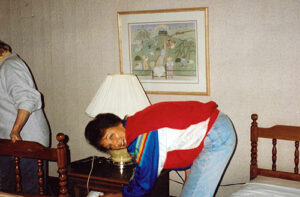
JLA President, Barbara Hoehn, setting up a bedroom at Albany’s Ronald McDonald House.
Junior League Members served on the public relations committee to draft press releases and be part of a “speakers bureau” to speak to the public about RMH’s history and purpose.
The House Operations committee’s went to work overseeing fire safety, sprinkler and telephone systems, researching building codes & hotel standards, training volunteers, and hiring a House Manager – the legendary Debbie Ross, who lived in the house and managed it for over 41 years.
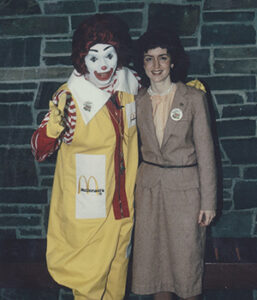
Debbie Ross and Ronald McDonald
The House Furnishings committee worked with the House Renovations committee to make it a comfortable, accessible home with wheelchair ramps, large kitchens for multi-family food prep, new paint, and build out a house manager’s apartment.
The Fundraising committee helped to raise thousands of dollars to accompany McDonad’s co-op contribution of $125,000. The Budget committee located bank financing, set up accounts and a house operations & renovation budget. The JLA worked with local Ronald McDonalds owner operators to secure donations.
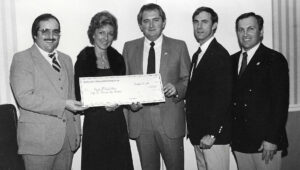
Hoehn with $62,900 donation from McDonald’s Albany Advertising Co-Op in 1984.
Even Albany Mayor, Erastus Corning, heard of the great work happening and wanted to help. “Boy, anything I can do.” His last moments in Albany were at the House’s grand opening, before he left for Boston for final medical treatment.
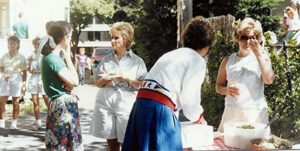
JLA volunteers on a lunch break at the Ronald McDonald House.
The result
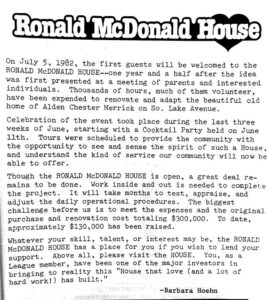
On June 30, 1982, only a hear and a half after its first planning meeting, Dr. Cromie’s dream came true when the eight bedroom Albany Ronald McDonald House welcomed its first guests, becoming the 35th Ronald McDonald House. According to him, it was “one of the most beautiful Ronald Mcdonald houses in the country…. and the most successful.”
“It would not have been as successful without the Junior League of Albany, due to their efficiency, clarity, ‘a woman’s touch’, civility & decorum,” said Cromie.
“The Albany Ronald McDonald House is clearly one of the Junior League of Albany’s greatest achievement which truly demonstrates the effectiveness of trained volunteers. And there is no better trained volunteer than the woman who has taken the leadership path through the Junior League of Albany,” said Barbara K. Hoehn, President 1979 – 1981
Over time, Albany Med’s neonatal intensive care unit grew and attracted more families to the area for care. “Babies were surviving.” Soon, families were turned away from the House, due to lack of space. Today, three Victorian houses make up one Ronald McDonald House, which has grown to 25 bedrooms. To date, more than 23,000 families have walked through their doors.
Ronald McDonald House Charities of the Capital Region receives no government funding. Donate to their mission to help families here.
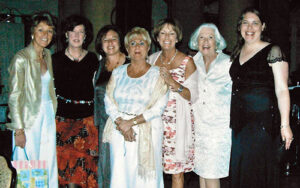
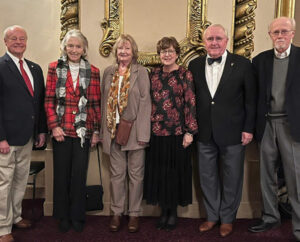
JLA members & past presidents at the 25th anniversary fundraisers in Saratoga’s Hall of Springs in 2007.