
St. Peter’s Hospice
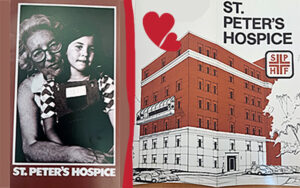
The Junior League of Albany Helped Create the First Hospice in New York State to offer inpatient & home care services.
the problem
Not all terminally ill individuals can die comfortably at home. A hospital room is often an undesirable setting to spend one’s final moments. Dr. Michael Murphy needed help from the Albany community to start a hospice center within St. Peters to offer dying patients and their families a loving, home-like place to spend those moments. Dr. Murphy’s vision included rooms for family members, reclining bedside chairs, soft lighting and deep, final conversations. In the 1970’s hospice services were commonplace in other countries, but a foreign concept here in the U.S.
The word “hospice” derives from the Latin hospitum, meaning “hospitality” or place of rest and protection for the ill and weary.
Lorraine Harper, a JLA member, was diagnosed with melanoma at 29. She met Dr. Michael Murphy and Father John Malecki when she was awarded Volunteer of the Year by the American Cancer Society Capital District for pairing new cancer patients with patients in remission. She was invited to serve on the hospice advisory committee and co-design a volunteer training program. Harper, Dr. Murphy & Father Malecki talked to radio shows, church groups and PTAs to educate the public & gather interest. “Everything I did was a result of my League training. No exaggeration,” said Harper.
She presented this hospice development project to the JLA board in 1979 for approval. She and Mary Gay, former JLA president, got to work assembling a team.
JLA in action
The JLA made up 3/4ths of St. Peter’s hospice’s volunteers and accomplished the below tasks:
- Furnished the rooms with plants, rugs, comfortable furniture
- Filled the day room with a rainforest of plants and kept them watered
- Cooked lunches & dinners for families
- Recruited musical groups for entertainment
- Sat with patients by their bedsides
- Educated the community by creating & funding pamphlets & videos and gave overviews to local organizations, such as Kiwanis club and fire departments.
- Attended workshops on death & dying to help cope with emotions
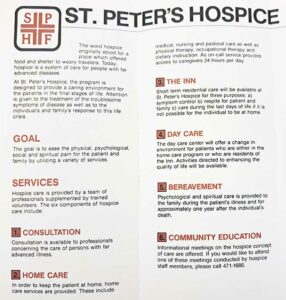
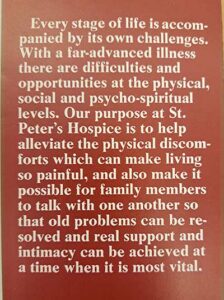
The results
St. Peters Hospice opened in 1983 to patients and their families.
“I got a lot more from these patients and families, than what I gave them. People amaze you,” said Mary Gay, who eventually became chief administrator of the hospice.
“It was a magical place nicknamed ‘The Inn.’ Hospitals are sterile places … At the Inn, you pushed open double doors and walked into sunny, airy rooms, with beautiful art by local artists on the wall, nice carpeting on the floors, a huge kitchen where families could make meals and everyone was invited. There was a salon where volunteers would cut and style patients’ hair.”
In the ’90s, St. Peter’s Hospice merged with other hospices and became The Community Hospice, one of the biggest nonprofit hospices in America.